
October 1, 2026
Buying Acreage in the Texas Hill Country
What to Consider
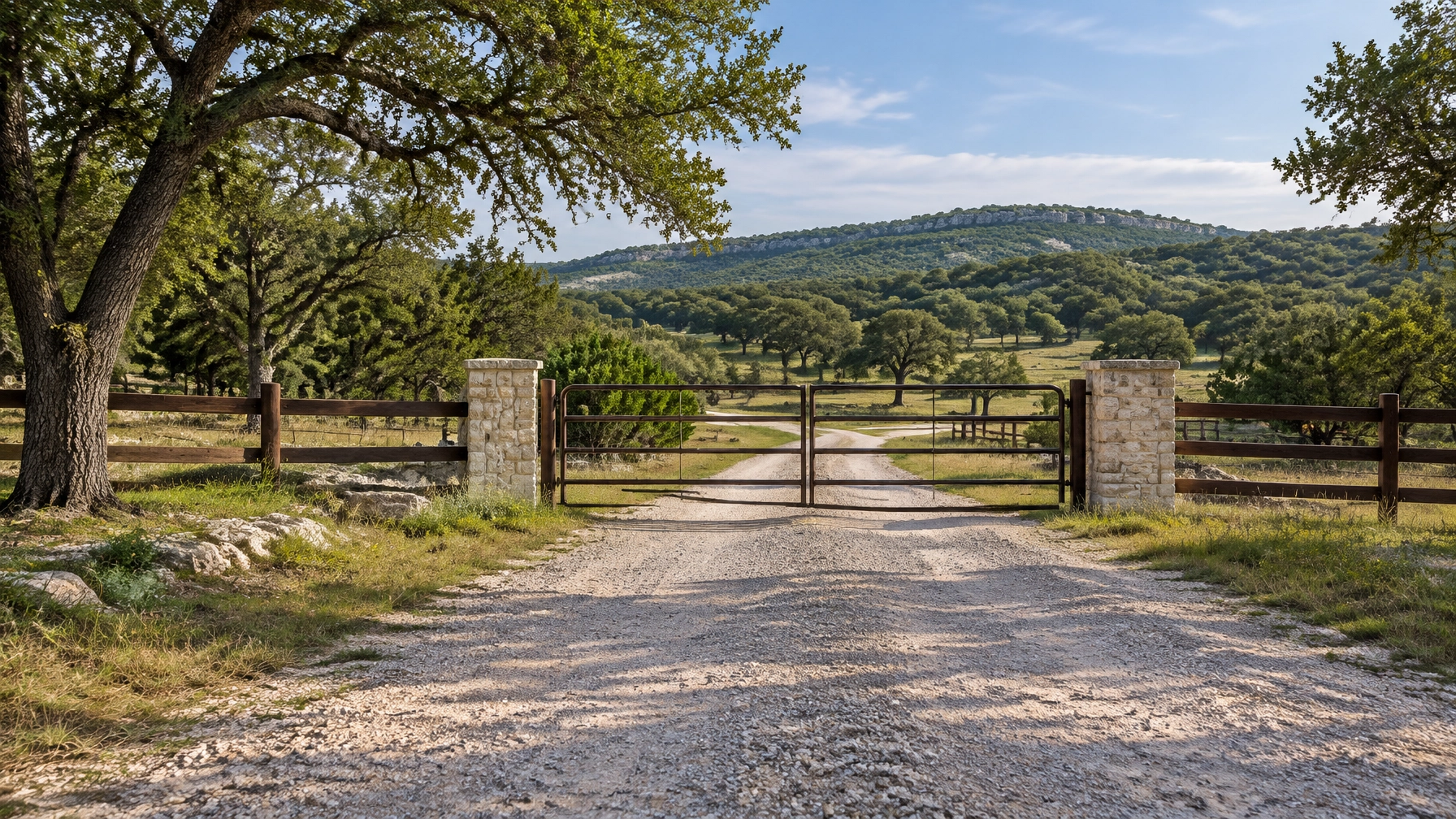
Buying acreage in the Texas Hill Country can offer room to breathe, build, garden, keep animals or simply enjoy a quieter pace of life. But rural property is different from buying a home in town. A beautiful tract of land may still require careful research into water, septic, access, utilities, taxes and land-use restrictions.
Whether you are searching for homes with land in Kerrville TX, land for sale in Kerrville TX, Hill Country acreage for sale or Fredericksburg acreage, the most important question is not only, “Do I love this property?” It is also, “Can this property support the way I plan to use it?”
Here are the main considerations for buyers in 2026.
Start with location, access and daily convenience
The Texas Hill Country covers a large area, and the experience of owning acreage can change significantly within just a few miles.
Properties closer to Kerrville may offer easier access to medical care, groceries, schools, restaurants and other services. Acreage along established corridors may also have better access to electricity, internet and maintained roads. Areas farther from town may provide more privacy, darker skies and larger tracts, but errands, emergency services and utility extensions may take more time and money.
When evaluating a property, measure the drive to the places you will use regularly, not just the distance on a map. Consider:
The condition of the road after heavy rain
Travel time to work, school or medical appointments
Whether the final road is public or privately maintained
Cell service along the route
Emergency access for fire, medical and utility services
Whether a driveway, gate or bridge crosses a creek or drainage area
Legal access is essential. Do not assume that physical access means legal access. Your title company should verify recorded easements, road rights and any shared-access agreements.
Understand deed restrictions, zoning and intended use
Texas rural property may have fewer traditional zoning controls than property inside a city, but that does not mean every use is allowed. Deed restrictions, subdivision rules, municipal boundaries and county regulations can all affect your plans.
Before making an offer, request the complete recorded restrictions and review them carefully. Look for limits involving:
Minimum home size or approved building materials
Guest houses, barndominiums or manufactured homes
Short-term rentals and commercial activity
Subdivision or future lot splits
Hunting, firearms or recreational activities
Livestock, horses, kennels or agricultural uses
RVs, workshops, barns and additional structures
A property advertised as having “light restrictions” may still prohibit a use that matters to you. Likewise, a property with no deed restrictions may still be subject to state, county or environmental requirements.
If you are buying near Kerrville or Fredericksburg but outside the city limits, confirm the exact jurisdiction. Requirements may differ between Kerr County, Gillespie County, the City of Kerrville and the City of Fredericksburg.
Water is one of the biggest questions
Many rural properties rely on a private well rather than municipal water. Well performance can vary considerably across the Hill Country, even between nearby properties.
For an existing well, ask for:
The well report and drilling records
Depth and construction details
Pump age and type
Recent flow or yield testing
Water-quality test results
Repair and maintenance records
Any well registration or groundwater district information
A well that serves one home may not support additional homes, irrigation, livestock operations or multiple guest structures. If you plan to build, ask a qualified well professional about likely capacity before assuming the water supply will meet your needs.
The Texas Water Development Board Groundwater Data Viewer and the TCEQ Water Well Report Viewer can help locate available records. These resources are useful starting points, but nearby well information is not a guarantee of results on a particular tract.

Septic systems depend on soil and site conditions
Outside municipal sewer service, most acreage buyers will need an on-site sewage facility, commonly called a septic system. Septic feasibility depends on soil, slope, groundwater, setbacks, available drainfield space and the proposed size of the home or development.
For an existing home, obtain the septic permit, site evaluation, system design and maintenance records if available. Have the system inspected by a qualified professional rather than relying only on a visual review.
For vacant land, ask whether there is a suitable area for both the primary system and a potential replacement area. A tract can be attractive yet difficult to develop if the usable building area is too steep, rocky, shallow-soiled or close to a creek.
Kerr County’s Environmental Health and OSSF information should be reviewed before planning a new septic system. Kerr County adopted updated septic requirements in 2026, so buyers should verify the current rules rather than relying on older advice about acreage exemptions.
In Gillespie County, the Sanitation Office and County Engineer’s Office provide information about septic, development determinations and floodplain-related requirements. In either county, confirm the current process before closing if your plans involve new construction.
Check electricity, broadband and road maintenance
“Electricity available” can mean several different things. It may mean a line is at the road, a meter is already installed or service is available nearby at an additional cost. Ask the utility provider for a written estimate if a line or transformer must be extended.
Also verify:
Whether the property has an existing electric meter
Who owns and maintains utility easements
Whether the power supply can support a workshop, well, barn or guest house
Propane or natural-gas availability
Internet provider, technology and installation cost
Cell service at the house site and throughout the property
Online broadband maps can be helpful, but actual service may differ because of terrain, tree cover or line-of-sight limitations. If remote work is important, test service at the exact homesite.
Road maintenance deserves equal attention. A private road may require annual contributions, shared grading agreements or individual responsibility for culverts and drainage. Read the road maintenance agreement and understand what happens when a neighbor does not contribute.
Study flood zones, drainage and topography
Hill Country properties can have dramatic elevation changes, rocky draws and seasonal creeks. Water may move across the land in ways that are not obvious on a sunny showing day.
Before making an offer, review:
FEMA flood maps
County floodplain information
The latest survey
Creek and drainage easements
Elevation changes and low-water crossings
Potential homesites outside mapped flood areas
Kerr County provides flood damage permitting guidance. Gillespie County also publishes flood-related information and ordinances through its County Engineer resources.
A property outside a mapped flood zone can still experience localized drainage problems. Walk the land after rain when possible, and ask the seller about past flooding, erosion and access interruptions. If you plan to build near a creek, have the proposed homesite and driveway reviewed before your option period expires.

Consider wildlife, fencing and agricultural use
Acreage may include deer, turkey, feral hogs, predators and other wildlife. Fencing that keeps livestock in may not keep wildlife out. Check the condition of boundary fences and determine whether they are shared, owned by one party or in need of replacement.
If you plan to keep horses, cattle, goats or other animals, evaluate:
Pasture quality and carrying capacity
Reliable water sources and trough locations
Barns, pens and shade
Gate access for trailers
Fencing height and condition
Feed and hay storage
Local restrictions on livestock
Ask whether the property currently has an agricultural or wildlife valuation. These valuations may reduce taxable value, but they come with eligibility and management requirements. Changing the use: or failing to maintain qualifying use: can affect future taxes and may lead to rollback taxes.
Review the property’s records with the appropriate county appraisal district and consult a tax professional before assuming an exemption will continue after purchase.
Budget for insurance, taxes and financing
Rural insurance may differ from a standard homeowners policy. Ask an insurance professional about coverage for wildfire, wind, hail, detached structures, livestock, wells, septic systems and flood risk. Flood insurance may be required by a lender in certain areas and may be worth considering even when it is not mandatory.
Financing also varies. Raw land, improved acreage and a home with acreage may qualify for different loan products. Land loans often require more money down and shorter repayment terms than a conventional home mortgage. Some sellers offer owner financing, but buyers should carefully review the interest rate, amortization period, balloon payment, default provisions and prepayment terms.
Obtain financing guidance early, especially if you are comparing land-only purchases with homes that already have utilities and improvements.
A practical due-diligence checklist
Before making an offer: or during the option period: try to verify:
Legal access, road maintenance and recorded easements
Deed restrictions, HOA documents and permitted uses
Well records, water quality and production capacity
Septic permits, inspections and replacement-site feasibility
Electric, propane, internet and cell-service availability
Survey, boundaries, encroachments and mineral considerations
FEMA flood zone, county floodplain rules and drainage
Agricultural or wildlife valuation and current tax records
Fencing, livestock facilities, wildlife and hunting rules
Insurance availability and realistic construction costs
This information is general education, not property-specific legal, engineering, tax, lending or environmental advice. Each tract should be evaluated based on its own documents, improvements, terrain and intended use.

Finding the right balance between privacy and convenience
The ideal acreage is different for every buyer. Some want a manageable homesite near Kerrville with room for a garden and workshop. Others prefer a larger ranch between Kerrville and Fredericksburg, accepting longer drives in exchange for privacy, views and open space.
The right property is not necessarily the most remote or the closest to town. It is the one that fits your budget, daily life and long-term plans: with enough water, access, infrastructure and flexibility to support those plans.
If you are exploring Texas Hill Country real estate, homes with land in Kerrville TX or Fredericksburg acreage, Monika Bury can help you evaluate the practical details alongside the scenery. Explore current listings or search available properties, and reach out when you are ready for local guidance.
Building dreams and serving with the heart, Monika is here to help you move toward the property: and the Hill Country lifestyle that feels like home.